How to Design a Nurse Call System
In modern day healthcare environments, whether this be hospitals or care homes settings, effective communication between patients or residents and staff is absolutely critical. A well-designed nurse call system not only helps to protect the safety and dignity of those in care, but also supports operational efficiency, compliance, staff morale and resident satisfaction.
At Courtney Thorne we’ve been working with hospitals, care homes and other healthcare providers since 1968, helping them to design and install nurse call systems tailored to their specific needs. This article aims to guide hospital staff and care-home operators through the process of designing a nurse call system, including a brief summary of what a nurse call system is, the different options that exist, what accessories you might include to customise for your environment, and how to approach design in different healthcare settings.
What is a Nurse Call System?
In simple terms, a nurse call system (sometimes referred to as a call-bell system) is a communication tool that allows a person receiving care (a patient in a hospital, a resident in a care home) to signal a need for assistance from a nearby carer or nurse. This alert carries important information to the relevant staff member, such as the location of the call, the type or level of assistance required, and the call time. A nurse call system when implemented effectively becomes a backbone of the care service, providing rapid responses, increased resident safety, fall prevention, and even data collection and management.
What are some examples of Nurse Call System Design?
When designing a nurse call system you need to consider what type of system best suits your building, your staffing model and your care-profile. Here are some of the main “types” of nurse call systems, with examples of how they differ. These are drawn from our range at Courtney Thorne.
Wireless Nurse Call System Designs
A wireless nurse call system offers a flexible, non-invasive solution that’s ideal for care homes or hospitals where minimising disruption is essential. Using secure radio signals instead of cabling, call points communicate directly with control units or mobile applications. Wireless systems, like our Altra range, combine hospital-grade reliability with strong encryption and long-life battery management, ensuring safety without sacrificing convenience. They can even integrate effectively with mobile alerts and cloud-based reporting, enabling staff to respond efficiently while monitoring performance data.
Wired Nurse Call System Designs
A wired nurse call system uses structured cabling to connect call points, over-door indicators and control panels throughout a building, as opposed to any wireless components. Because signals are transmitted via fixed wiring, interference is virtually eliminated, making wired systems ideal for new-build hospitals or major refurbishments where infrastructure can be planned during construction. They also integrate easily with wider monitoring or building systems. Although installation can be more disruptive and time-consuming, a wired solution provides long-term stability, minimal maintenance and exceptional dependability overall.
Hybrid Nurse Call System Designs
A hybrid nurse call system blends the resilience of wired infrastructure with the adaptability of wireless technology, creating a future-proof and versatile communication network. They best suit facilities combining older and newer buildings or those expanding over time. In a hybrid setup, critical areas such as wards and bathrooms may use wired call points for maximum reliability, while wireless accessories, like pendants or pressure mats, add flexibility where needed. At Courtney Thorne, hybrid solutions are often recommended for large hospitals or care groups seeking the stability of wired systems alongside the mobility of wireless devices, resulting in scalable and efficient nurse call solutions.
What are Nurse Call Accessories?
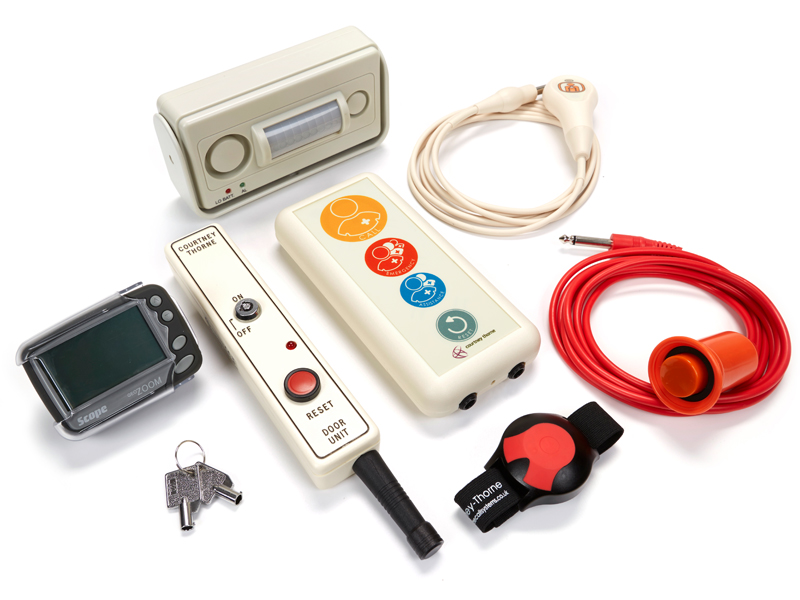
Once you have your core system architecture in place, you can start to consider the “extra” devices that fine-tune how the system works. These are what we at Courtney Thorne refer to as Nurse Call Accessories. Using these accessories, you are able to customise and refine your nurse call system into a more bespoke solution that perfectly suits your unique environment. Some common examples of nurse call accessories include the following:
- Display Panels: Interactive panels that show calls and allow staff to manage them.
- Over-Door Lights: Lights that show at a glance which room has an active call.
- Wearable Pendants: Wrist-wearables or necklaces for patients/residents to call for help from anywhere within range.
- Pressure Mats: Used to detect someone leaving a bed or chair via infrared sensors for falls.
- Mobile Integration: Our Altra Go app enables staff to receive alerts on Android devices showing location, source, severity.
- Cloud-Reporting: Our CT Cloud reporting solution allows for remote monitoring of call data, analytics, shift peak/troughs, response times, care trends.
- Staff Attack Solution: Discreet personal alarms for staff to summon help in emergency/aggressive behaviour situations.
How Nurse Call Accessories are used to customise our systems
Customisation is key: your facility’s layout, staffing model, resident profile and objectives will all differ, so using accessories judiciously lets you fine-tune the system rather than adopting a “one-size-fits-all”-approach. From Courtney Thorne’s experience, here is how you can think about customisation using accessories:
| Customisation Style | Description |
|---|---|
| User Type Customisation | For example, residents with limited mobility may benefit from wearables or bed-exit sensors; in contrast, ambulant patients may simply need standard bed/cord buttons. |
| Zone-Specific Triggers | A bathroom or ensuite may require a pull-cord plus over-door indicator; communal lounge spaces may need wall buttons, wearable devices and perhaps pressure mats. |
| Staff Workflow Customisation | If your staff carry mobile devices or use pagers, you can integrate with the Altra Go app so that calls go straight to smartphones; this improves response time, while reducing reliance on central stations. |
| Environmental Customisation | In a listed building where wiring is challenging you might lean more on wireless accessories and portable wearables; in a new build you might integrate wired over-door lights and fixed touchscreen panels. |
| Reporting & Analytics Customisation | You can use cloud-reporting accessories (CT Cloud) to tailor dashboards for your organisation. For example, you can filter data by shift, room-type, call-severity, identify peaks and troughs, and benchmark performance. |
| Safety Enhancement Customisations | If your staff are likely to face aggressive behaviours, integrating our Staff Attack Solution can make it so that staff have personal alarms to safeguard their wellbeing that is linked into the wider nurse call infrastructure. |
How do we approach nurse call system design for different environments?
Different care environments have different requirements, and while the same core principles will apply to most (such as safety, reliability, response-time, data-tracking) the details will usually vary. Below is an outline of how we at Courtney Thorne approach nurse call designs for two major categories: hospitals and care homes.
Hospital Designs
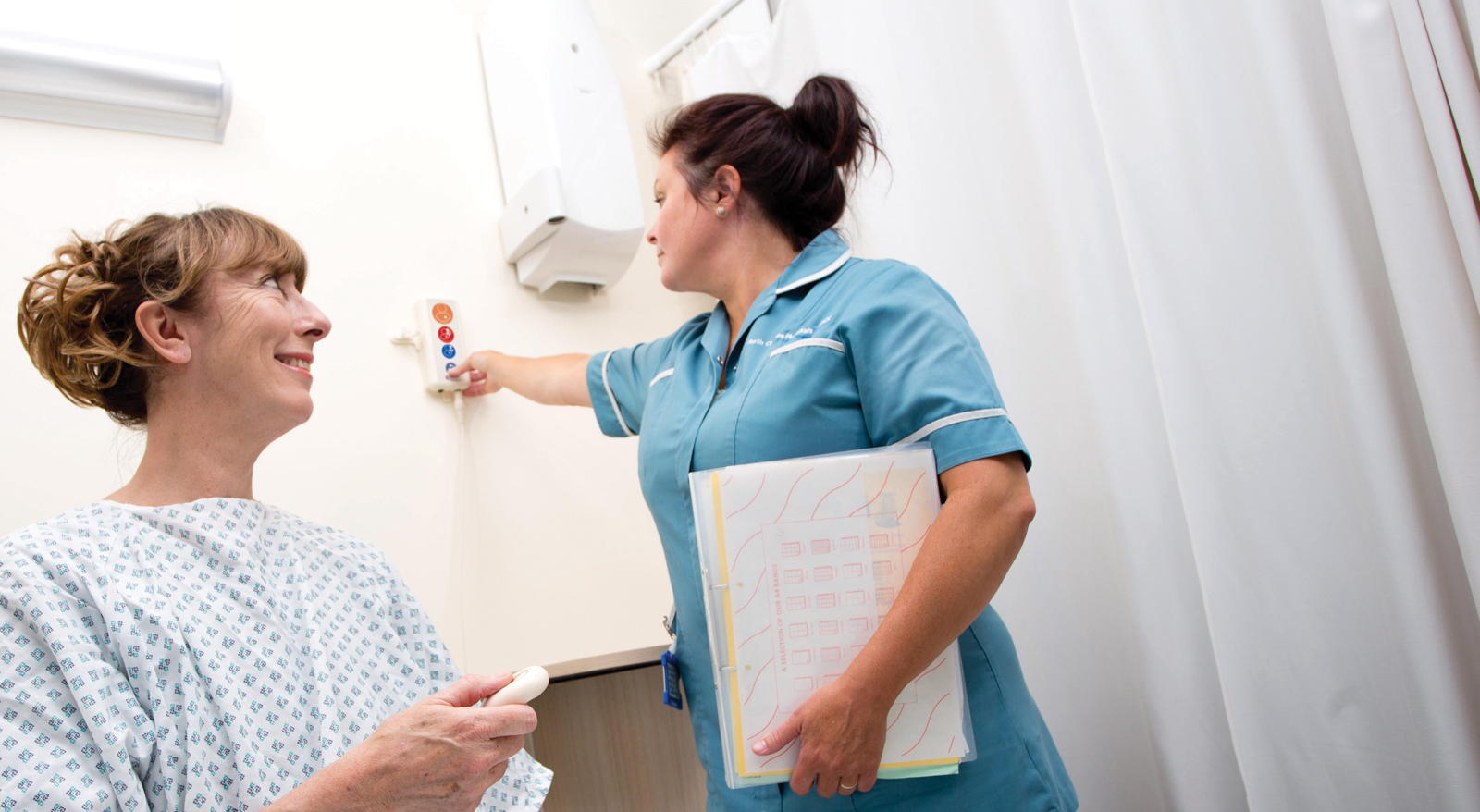
Designing a nurse call system for a hospital requires careful attention to reliability, compliance and efficiency, as hospitals operate in such a way that communication will directly impact patient safety. For example, a well-designed nurse call system within hospitals must combine fixed call points at each patient’s bed with emergency and bathroom pull cords for more vulnerable patients, over-door indicators and central displays that allow staff to identify and prioritise calls instantly–all while complying with standards like HTM Regulations. Increasingly, many hospitals are even beginning to integrate mobile alerts via smartphones or pagers; so that staff can respond rapidly while on the move.
In larger or more complex estates, hybrid nurse call systems may prove ideal, due to the fact that they offer the stability of wired infrastructure with the flexibility of wireless accessories in temporary or specialist areas. Effective hospital nurse call system design should also account for any future expansions, minimal disruption during installation, and comprehensive staff training to ensure every team member, from nurses to porters, can use the system confidently and consistently.
Care Home Designs
In care homes and residential environments, nurse call system design focuses on promoting resident independence, dignity and comfort while ensuring staff can respond quickly and discreetly. Devices such as simple wall call points, wearable pendants and pressure mats can be positioned to match individual resident needs, ensuring help is always accessible. Discreet alerts to staff mobiles or handsets maintain a calm, homely atmosphere while enabling rapid response to calls. Via the integration of cloud-based reporting, compliance with regulatory standards such as CQC Standards is supported much more effectively, while also providing clear evidence of swift response times and good care quality. System design should also consider communal areas, outdoor spaces and en-suite facilities to provide comprehensive coverage throughout the home, which is where flexible, wireless accessories like wearables and sensors can prove especially effective.
Wireless or hybrid systems are often preferred in care homes, as they minimise disruption during installation and suit the flexible layouts typical of care facilities. By prioritising ease of use, resident comfort and reliable connectivity, our nurse call systems for care homes enhance safety without compromising the warmth and familiarity of the living environment.
Designing an Effective Nurse Call System: Step-by-step
Hopefully, you will now have a much better idea as to what goes into the design process of a nurse call system. Whether this be one that utilises wired or wireless technology for a hospital, care home, or any other healthcare environment, a good quality nurse call solution takes into account the needs of the patient, the staff, and the environment itself. Below, we outline some appropriate steps you can take in order to define and action a nurse call system that’s tailor-made for your facility:
1. Conducting a Needs Assessment:
The design process begins with a clear understanding of your facility’s layout, care model and operational needs. Mapping resident rooms, bathrooms and communal areas helps identify where call points, pull cords and sensors should be installed. This stage also considers staff workflows, care levels and any building limitations that may affect installation. By defining these requirements early, you ensure the system is tailored to your environment, compliant with regulations, and fully aligned with your care objectives.
2. Selecting the System Type
Choosing between wired, wireless or hybrid systems depends on your building, budget and long-term plans. Wired systems offer unmatched reliability for new builds and hospitals; wireless systems suit existing sites or listed buildings where cabling is impractical; and hybrid systems combine both for flexibility. Whichever option you choose, ensure it meets relevant standards such as HTM 08-03 and integrates with mobile alerting or cloud analytics to create a future-ready communication platform.
3. Defining Accessories and Customisation
Once the core system is selected, accessories can be tailored to enhance usability and safety. Options such as over-door lights, wearable pendants, pressure mats and mobile apps allow for custom configurations suited to each care environment. Fall-risk residents might need bed sensors, while communal spaces benefit from discreet wall call points. This stage ensures every alert pathway, from wall panel to staff mobile, is optimised for both responsiveness and simplicity.
4. Installation Planning
Effective installation planning minimises disruption and ensures full system coverage from day one. Detailed schedules, cabling designs and wireless surveys are carried out to guarantee reliable operation. Staff training is a crucial part of this phase, equipping every team member to use, manage and interpret the system correctly. A smooth installation process promotes confidence and ensures the technology integrates seamlessly into everyday workflows. You can visit our Support hub for more information regarding these training guides and resources.
5. Go-Live and Ongoing Monitoring
After installation, the system enters the live phase, supported by testing, data monitoring and fine-tuning. Platforms like Courtney Thorne’s CT Cloud help track call volumes, response times and activity peaks, guiding staffing and service improvements. Regular maintenance and user feedback keep the system efficient and reliable, ensuring long-term safety and performance as your organisation’s needs evolve.
Final Thoughts on Nurse Call System Design
Designing an effective nurse call system is ultimately about creating a safer, more responsive care environment–one where patients, residents and staff are all supported by technology that works seamlessly in the background. A well-considered design brings together reliability, usability and flexibility, balancing technical performance with the human aspects of care. From understanding how people move through a building to selecting accessories that complement day-to-day routines, each design decision shapes how communication happens when it matters most. The most successful systems are those built around real-world needs: intuitive for residents, empowering for staff and robust enough to evolve with future demands.
At Courtney Thorne, we believe that designing a nurse call system should be a collaborative process, rooted in listening, understanding and tailoring every detail to the environment it serves. Our decades of experience across hospitals, care homes and specialist facilities mean we can advise on the right blend of technology, functionality and care-focused design. If you’re exploring how to improve or modernise your nurse call infrastructure, our team would be delighted to discuss your needs and help shape a solution that enhances both safety and quality of life–if you’re interested, you can contact us directly to start that conversation right away.
Written by
Date
03.11.25

Courtney Thorne
C-T Centre
Elliott Road
Bournemouth
United Kingdom
BH11 8JS
Copyright ©2026.
Copyright Courtney Thorne Ltd
Registered in England and Wales. Company No 04319825.
This website has been designed and built by CuCo Creative.