Warrington Hospital
Case Study
Warrington Hospital
Warrington, Cheshire
A flexible, scalable nurse call system with accurate response rate data
Warrington Hospital, part of the Warrington and Halton Hospitals NHS Trust, is one of the UK’s hospitals that are admitting increasing numbers of elderly patients in dementia. The Government’s £50 million dementia care fund recognises the urgent need to address this trend with specialist care and facilities. This case study shows how flexible nurse call systems can shape critical specialist care and facilities for patients.
Warrington Hospital began by forming a consultation group to support the design and specification of the Forget-Me-Not Dementia Unit. The group comprised patient and carer representatives, members of the Estates team, clinical professionals and representatives from the Alzheimer’s Society to ensure both practical and social considerations were incorporated.
Among the practical elements, a nurse call system was critical, ensuring not only that patients can call for prompt assistance when needed, but also that a degree of flexibility is built into the unit, as Lee Bushell from the hospital’s Estates Capital Projects team explained:
“We had been upgrading the hospital to Courtney Thorne’s 08 wireless nurse call system on a rolling programme of ward refurbishments since 2012, so we knew we could be confident it would be reliable. We also needed a system that was both flexible and scalable should we need to reconfigure or extend the unit in the future. The wireless system means we can make changes without any rewiring.
“Any hospital ward needs to use management information to monitor standards of care and plan staffing levels, but in a dementia unit that’s particularly important because staff ratios need to be higher and patients often become disoriented and may complain that nurses have taken too long to respond. The data recorded by the Courtney Thorne system ensures we have accurate information about response rates, helping us reassure relatives of the standard of care.”


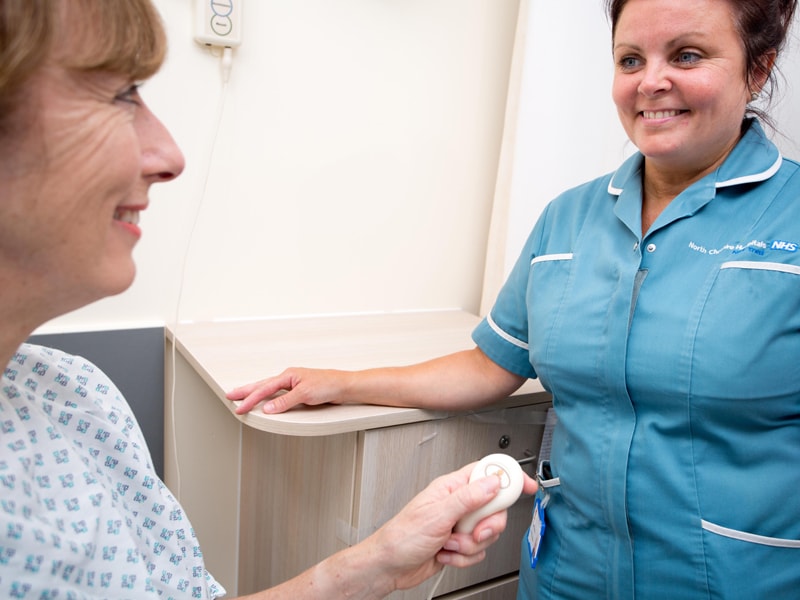
"…the Courtney Thorne nurse call system ensures we have accurate information about response rates, helping us reassure relatives of the standard of care."

Prioritised comfort, safety and high standards of care
That standard of care is exceptionally high, thanks in no small part to the custom-designed dementia environment. Every element of the layout and decoration has been designed to reduce patient anxiety and disorientation while encouraging social interaction, independence and stimulation. Colour plays a pivotal role too, with colour-coded doors and door frames to help patients identify different areas, such as toilets, and neutral-coloured doors for staff-only areas to deter patients from entering.
“We found that dementia patients often want to go home and the virtual bus stop we provided gives them an area where they can go and sit to wait for their bus to come. Staff who see a patient sitting alone at the bus stop chat to them and reassure them and many patients like to use it as a social area too. Other social areas include the dining room and a quiet room where an old style TV screen shows images of local scenes from the 1950s and 1960s.
“Our approach has been to prioritise comfort, safety and high standards of care in an environment that helps patients to feel at home by engaging with their long-term, functioning memory while providing strategies for addressing their lack of short-term recall.”