What is a Nurse’s Station & How are they Impacted by Nurse Call Systems?
In the dynamic environment of hospitals and care home facilities, efficiency, communication, and rapid response times are essential elements of the healthcare service. An often-overlooked linchpin of this system is the nurses’ station – a central hub for planning, coordinating, and implementing care. With the evolution of healthcare technology, particularly nurse call systems like those we develop at Courtney Thorne, the traditional role of the nurses’ station becomes even more prominent.
In this article, we will explore what a nurses’ station is, what its role is in a healthcare organisation’s environment, and how nurse call systems are reshaping their functionality to achieve better-quality patient care and more efficient clinical workflows.
What is a Nurses’ Station?
A nurses’ station is a designated area within a hospital, clinic, or healthcare facility where nurses and other medical staff can carry out all of their administrative duties. A nurses’ station functions almost as the brain of the ward or unit, from which operational commands are planned out and executed. The layout of a nurses’ station will naturally vary between facilities, depending on the needs of both the staff, the patients, but the purpose remains consistent – to ensure that timely, effective care is delivered consistently, while serving as a centralised point of communication.
What is the Purpose of a Nurses’ Station?
The primary purpose of a nurses’ station is patient management and care coordination. It acts as the logistical and communication hub, allowing nurses and staff to:
- Monitor the vitals of patients and check for alerts.
- Communicate with team members and colleagues.
- Look at, update and review patient records.
- Efficiently schedule medication delivery, appointments, and procedures.
- Respond to nurse call alerts, patient requests and other medical emergencies
In some facilities, a nurses’ station also serves as the first point of contact for visitors and patients requiring assistance, often being built into the same interior structure as the reception desk or “visitors centre”. In these instances, a nurses’ station bridges the gap between administrative duties and forward-facing care, ensuring that the providing of healthcare remains a smoother process for all parties involved.
Where is a Nurses’ Station typically Located?
A nurses’ station will ideally be positioned so that care staff have easy access, while having optimal visibility over the surrounding area. In most hospitals or care homes, a nurses’ station is positioned centrally in a ward, allowing for clear visibility of patient rooms, often in line-of-sight with the most critical patients or high-risk zones. This positioning is designed to enable swift access to all rooms within the unit without needing to travel longer distances than required. When positioned in this manner, response times in emergencies are shortened, allowing for quicker, more effective decision making.
Why are Nurses’ Stations Important for Hospitals?
A nurses’ station is not just a physical structure – it’s a hub of clinical intelligence, operational efficiency, and responsive care delivery. Its strategic importance can’t be overstated, particularly as healthcare systems face increasing pressure to deliver faster, safer, and more personalised care. In the table below, we will explore a few of the ways in which nurses’ stations greatly benefit hospital operations.
| Nurses’ Station Benefit | Description |
|---|---|
| 1. Centralised Communication | Nurses are able to easily relay information between departments, physicians, and families from this centralised hub. |
| 2. Emergency Response Coordination | In high-pressure scenarios, a nurses’ station enables the immediate mobilisation of the entire care team. |
| 3. Operational Oversight | The scheduling of all staff and their tasks, the allocation of resources, and the distribution of work is often managed at nurses’ stations. |
| 4. Patient Monitoring | Integrated technology allows for real-time surveillance of patient statuses, especially relevant in ICUs or elderly care facilities. |
| 5. Professional Collaboration | A nurses’ station also provides a clear space where teams can discuss different patient care strategies. |
Nurse Call Systems & Nurses’ Stations
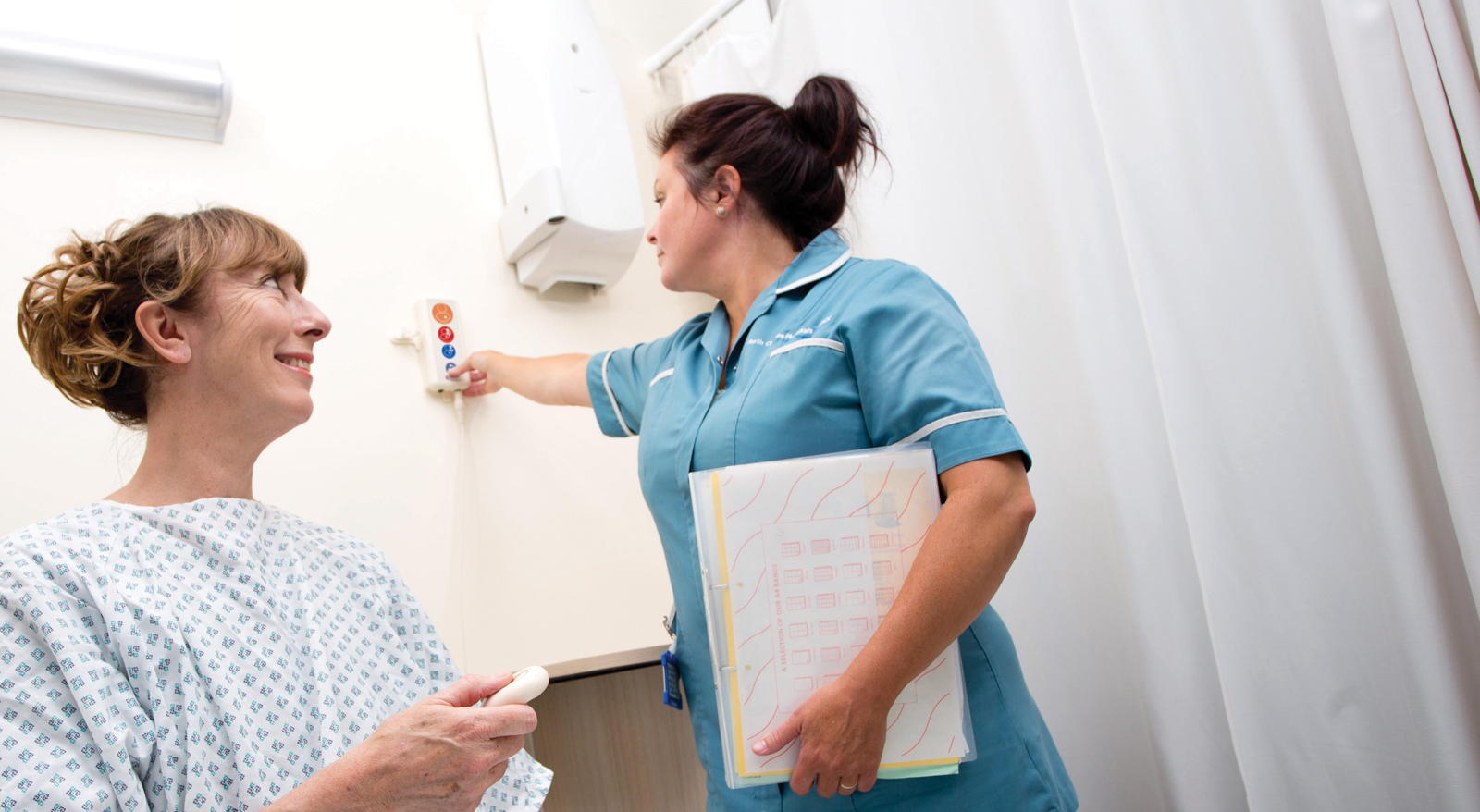
As healthcare demands grow more complex, so too must the systems that support care. A nurse call system is a communication platform that enables patients to alert staff to their needs or emergencies, usually via a button at their bedside. These systems can range from basic buzzers, to advanced digital platforms that integrate with patient records, mobile devices, and even predictive analytics – all features that are greatly appreciated in the administrative hub of the nurses’ station. These more modern systems are the ones that we at Courtney Thorne specialise in.
What is a Courtney Thorne Nurse Call System?
We are one of the UK’s leading providers of nurse call systems, with over 50 years of experience in healthcare technology innovation. We aim to deliver nurse call solutions that are:
- Flexible and Modular: Easily installed and scalable for facilities of all sizes.
- Data-Driven: Offering analytics on response times, call frequency, and staff performance.
- User-Centric: Designed with input from healthcare professionals to optimise usability and reliability.
- Easily Integrated: Can be linked with other hospital systems such as electronic health records (EHR), mobile devices, and building management platforms.
A Courtney Thorne system doesn’t just notify a nurse; it intelligently routes the call to the appropriate staff member, logs the event, and tracks resolution – all while feeding into a central management system; often located at the nurses’ station.
How our Nurse Call Systems work in Nurses’ Stations
Our modern wireless nurse call systems make for a seamless addition to any nurses’ station. In the bullet points below, we can examine the process of what happens when a nurse call system is used by a patient, and how this feeds back into the station itself:
- A patient presses the call button at their bedside, pulls the cord in bathroom, or initiates a fall sensor.
- The alert is immediately sent to the nurses’ station, as well as to assigned nurses’ mobile devices via the Altra Go app.
- The display screen at the nurses’ station highlights important information like the room number, patient profile, and priority level of the call.
- If the call is not acknowledged within a preset time, it will pass over to the next available team member.
- Once attended to, the system logs the time of response and duration – feeding this back to the nurses’ station dashboard. This information can then be accessed at any time at the station, via our CT Cloud Reporting technology.
This feedback loop turns the nurses’ station into a live monitoring and coordination hub, not just a passive relay point. It empowers staff with data, reduces errors, and ensures that patients receive timely and appropriate care.
How are our Nurse Call Systems Beneficial for Nurses’ Stations?
By utilising the characteristics of our nurse call systems for hospitals and care homes, these facilities can greatly benefit from how they coordinate and manage tasks through nurses’ stations. Our nurse call systems are beneficial for nurses’ stations in the following ways:
| Nurse Call System Benefit | Description |
|---|---|
| 1. Improved Workflows | With intelligent filtering, nurse call systems reduce the number of unnecessary alerts – freeing your staff at stations to focus on more urgent or critical tasks. |
| 2. Intuitive Communication | With mobile integration via the Altra Go app, nurses can respond to calls without returning to the station, helping to streamline workflows and clearing space at the nurses’ station itself. |
| 3. Better Analytics | Call logs, response times, and patient trends are recorded automatically, allowing nurses’ stations to function as a stronger data hub, informing decisions and care quality improvements. |
| 4. Stronger Compliance | Detailed audit trails help organisations meet compliance requirements, while also providing insights into patterns that could influence risk mitigation strategies. |
| 5. Adaptability | Whether it’s a 20-bed care home or a multi-ward hospital, Courtney Thorne systems can be scaled accordingly, supporting nurses’ stations across different environments. |
Final Thoughts on Nurses’ Stations and Nurse Call Systems
The nurses’ station remains a vital cog in the machine of modern healthcare. It is where communication converges, patient care is coordinated, and clinical insight is managed. However, the demands of 21st-century care require that these hubs be technologically supported to operate at peak efficiency. Healthcare environments are under increasing strain from things like staff shortages, a rising number of patients, greater expectations, and an increased need for compliance to regulations. Nurse call systems offer a digital solution to these very human problems. By relieving the communication burden on nurses’ stations, staff can spend more time on direct patient care rather than administrative logistics.
If you’re part of a healthcare organisation looking to upgrade your patient response capabilities, or simply streamline operations at your nurses’ stations, we invite you to get in touch with Courtney Thorne. Our expert team is ready to help you find the best-fit solution tailored to your environment.
Written by
Date
06.08.25


Courtney Thorne
C-T Centre
Elliott Road
Bournemouth
United Kingdom
BH11 8JS
Copyright ©2026.
Copyright Courtney Thorne Ltd
Registered in England and Wales. Company No 04319825.
This website has been designed and built by CuCo Creative.